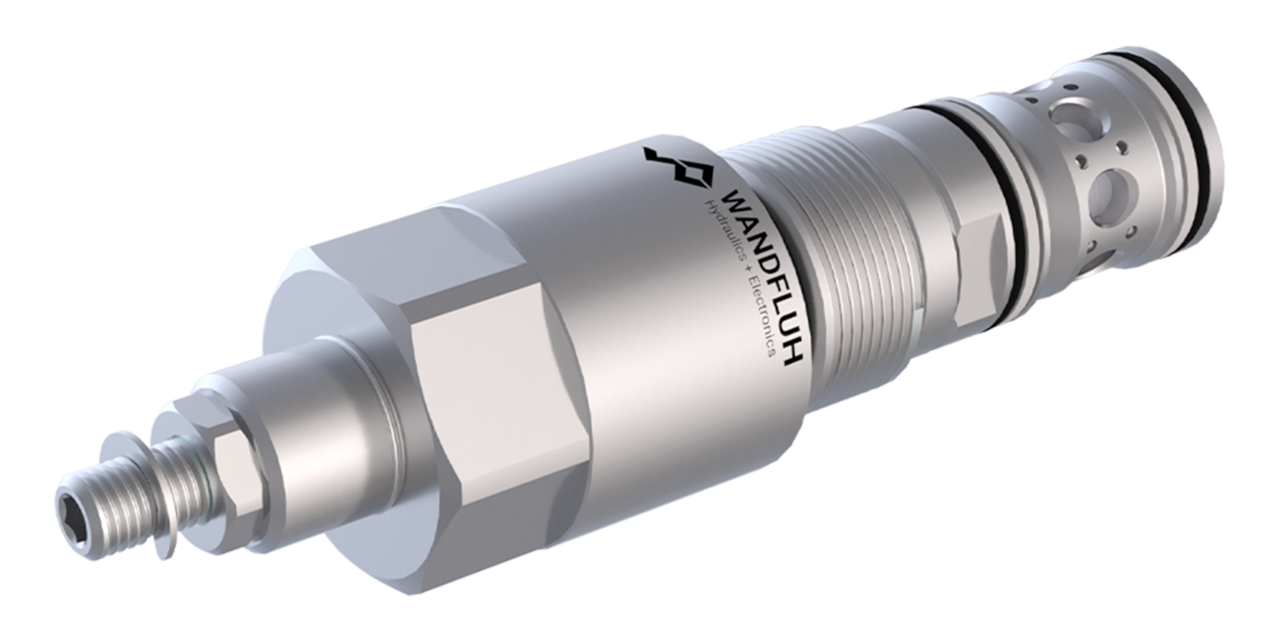
Bypass pressure compensator valve
Description
Bypass pressure compensator valve in screw-in cartridge design with adjustable or fixed pressure balancing spring. The task of the bypass pressure compensator is to keep the pressure drop across a throttle point (e.g., control edge of a proportional directional control valve) constant and to direct the excess volume flow to the tank at the load pressure level. It ensures that a specific amount of oil, independent of the load pressure, flows through the spool valve at a specific position of the control piston. Bypass pressure compensators are mostly used in constant pump drives in conjunction with proportional valves, but can also be used with orifices or throttle valves to ensure constant volume flow control. The corresponding system is commonly referred to in technical terminology as an OCLS (Open Center Load Sensing) system.
Application
The bypass pressure compensator regulates the volume flow independently of the load pressure at the consumer. Cylinders or motor speeds remain constant. The excess volume flow is fed back to the tank at load pressure level. This results in what is known as 3-way flow control. The adjustable pressure compensator spring allows the user to optimize the system directly at the installation. To secure settings, the adjustment screw can be fitted with a locking cap. A lockable version is also available. These allow the bypass pressure balance to be adapted to changing pump systems, such as constant pumps (OC systems) or pressure-flow-controlled pumps (LS systems). This is often the case with towed mobile machines.
Key facts
Bypass pressure compensator valve
- Qmax = 150 l/min
- pmax = 350 bar
Contact us now
Do you have questions about this product or need help finding the best solution for your project? Our network of experienced sales experts is here to support you – personally, competently, and close to you.
To the sales network